Lucitech Research Workflow
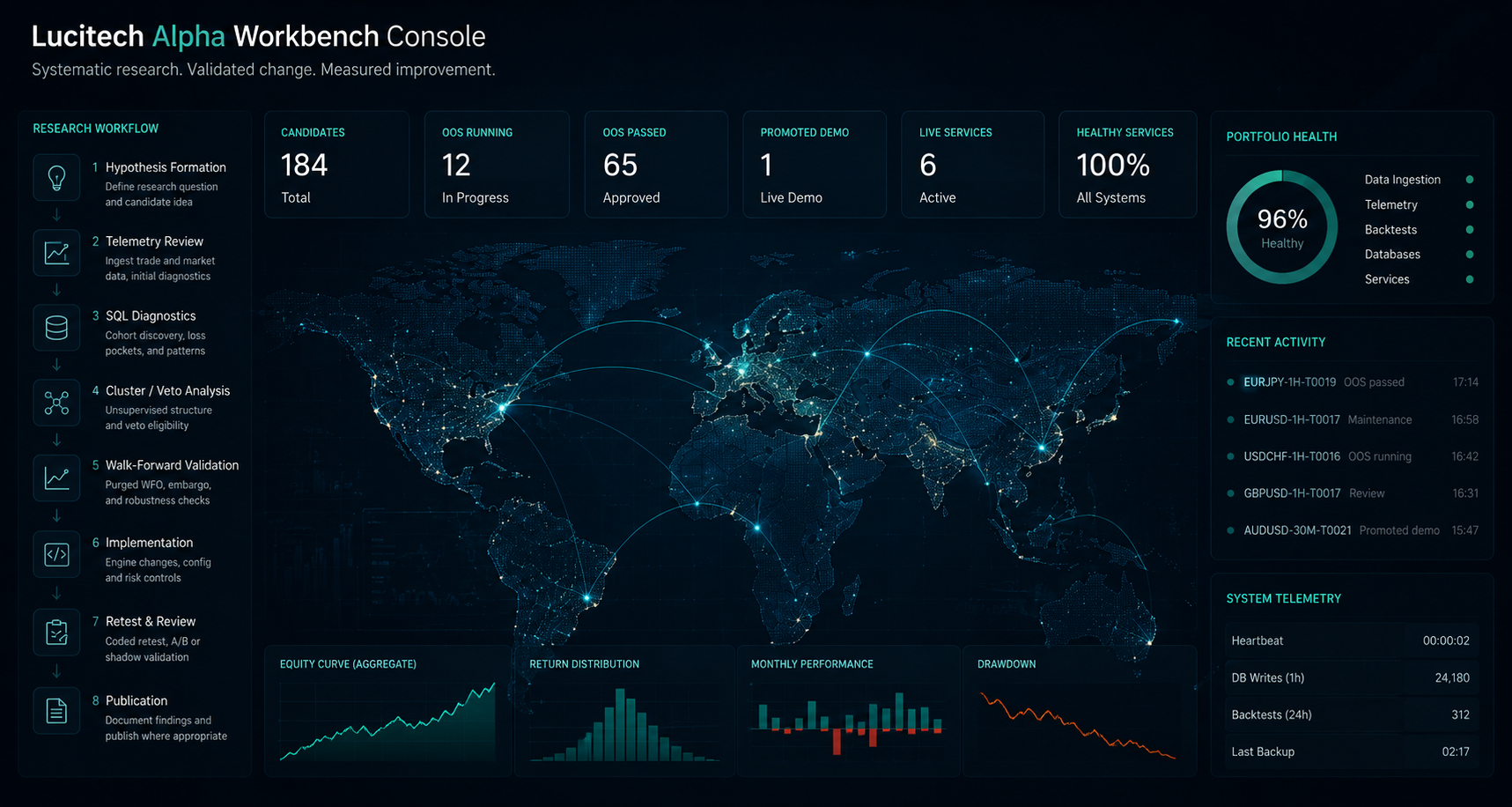
A high-level view of the workflow used to investigate strategy behaviour, test hypotheses responsibly and validate targeted changes without relying on black-box optimisation.
Workflow Sequence
Hypothesis
Define the research question and the behaviour or weakness being investigated.
Data Cleansing
Prepare and scope market, trade and event data so the analysis starts from trustworthy inputs.
Telemetry Review
Examine execution context, trade-state information and supporting telemetry at decision time.
Analytics
Analyse cohorts, behaviour and outcomes to identify interpretable patterns and weak areas.
Cluster / Veto Discovery
Identify candidate interventions, loss pockets or rule refinements worth testing further.
Engine Validation
Test changes in the execution environment to confirm the intervention behaves as intended.
Re-test & Document
Re-evaluate results, record findings and feed the next iteration of the research cycle.
The emphasis is on disciplined iteration: investigate, validate, review and only then promote a change into the evolving research process.
What the Workflow Protects Against
Reducing self-deception
Patterns in market data can appear compelling but fail under retest. The workflow keeps attractive results under review until they survive further evidence checks.
Audit before promotion
Candidate changes are documented through run IDs, telemetry, diagnostics, review status and retest results, so later decisions can be explained.
Implementation matters
A rule that looks useful in analysis still has to behave correctly in the execution engine, under the same assumptions used by the strategy.
Related Work
The workflow is implemented through the emerging Alpha Discovery Workbench: a research and control layer for candidate surfacing, telemetry review, validation, maintenance and publication of evidence where appropriate.