Fragmented research
Backtests, scripts and notebooks accumulate without durable provenance or repeatable evidence gates.
Systematic trading research, validation and engineering
Lucitech builds the research, validation, deployment and telemetry systems that connect serious market hypotheses to controlled live operation.
Small trading teams often lack the engineering system that connects research evidence to controlled operation. Lucitech brings that chain together without treating a backtest as proof.
Backtests, scripts and notebooks accumulate without durable provenance or repeatable evidence gates.
Moving from simulation to live capital exposes gaps in controls, deployment, observability and accountability.
Without comparable shadow and live telemetry, drift is difficult to explain and disciplined improvement becomes harder.
The output is not “a backtest”.It is a traceable decision record linked to a running system.
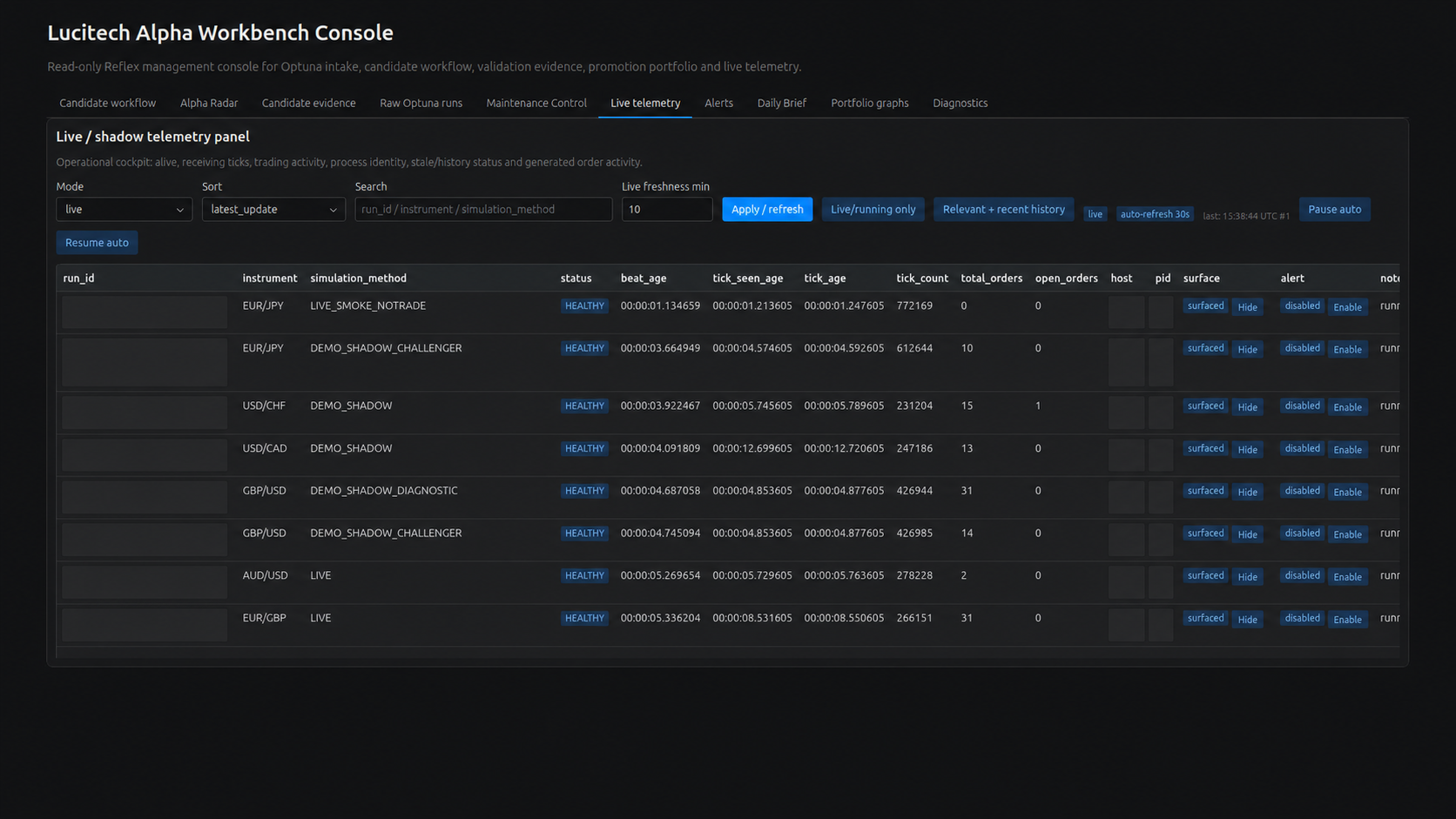
In July 2026, Lucitech deployed its first live micro-lot algorithm alongside a corresponding shadow runtime. Research, broker execution, persistence and Workbench telemetry now operate as one chain.
Lucitech considers a limited number of well-scoped engineering and sponsored R&D engagements where the problem, evidence gate, deliverables and IP boundaries can be stated clearly.